admin
adminKey Properties and Characteristics:
- Durability:
It's a hard and brittle metal, but also highly durable and resistant to wear and corrosion.
- Catalytic Properties:
Ruthenium is a highly effective catalyst, particularly in reactions involving the breaking and joining of double bonds in carbon atoms, as well as in various industrial chemical processes.
- Electronic Properties:
Ruthenium's ability to form stable nanostructures and conductive layers makes it essential in advanced memory devices and microelectronics.
- Jewelry:
Ruthenium's dark gray shine and hypoallergenic nature make it a popular choice for jewelry, often used as a plating material.
- Reactivity:
It's generally unreactive with air, water, and acids but can dissolve in molten alkalis.
- Rarity:
Ruthenium is one of the rarest metals on Earth.
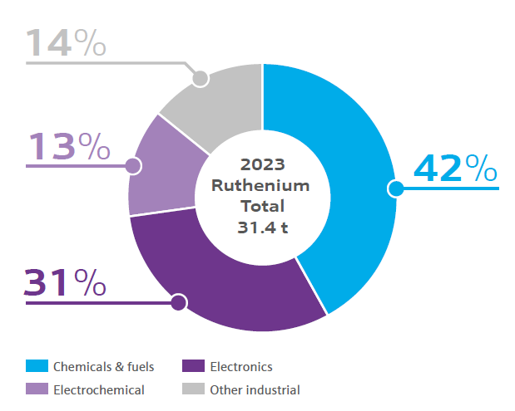
- Catalysis: Used in various industrial chemical reactions, including the production of acetic acid, ammonia, and polynorbornene.
- Electronics: Found in hard drives, memory devices, and microelectronic components.
- Jewelry: Applied as a plating material to create a dark, lustrous finish on jewelry.
- Alloys: Used as a hardening agent in alloys, especially for electrical contacts.
- Emerging Energy Technologies: Plays a role in hydrogen evolution and next-generation battery materials.
- Catalytic Converters: While not as widely used as other platinum group metals in catalytic converters, it still finds application in specialized catalytic systems.
Computer hard disk drive memory using ruthenium as an underlayer to its platinum-containing storage layer has enabled data storage density to greater increase.
Ruthenium is also widely used in electrochemical applications because of its wear resistance. Examples include:
- a coating on electrodes for chloro-alkali production
- electrocatalyst in gas diffusion electrodes (Ruthenium black)
- salt-water chlorination of swimming pools
- electrochemical treatment of shipping ballast water to kill invasive species
- often used in electrolysis with iridium.